
The Eighth-House Paradox in Vedic Astrology: Why Your Own Planetary Significations Can Feel Like Your Enemies
An advanced study of Ashtama Bhava, living significations, hidden opposition, planetary relationships and the experience of vulnerability in Jyotisha.
Introduction: When What Should Support You Becomes Difficult to Navigate
Why do certain areas of life become sources of repeated discomfort, even when they are represented by planets that are not inherently malefic?
Why can relationships become emotionally complicated, authority become a source of insecurity, communication become entangled with hidden information, or the pursuit of stability lead to situations that demand profound change?
And why can the very people, responsibilities and experiences associated with a particular planet sometimes feel as though they are working against the native?
These questions take us beyond the conventional interpretation of the eighth house as the house of longevity, death, inheritance, secrets and occult knowledge.
They lead us to a more fundamental question about planetary significations:
What happens when the natural and functional significations of a graha become connected with a bhava associated with vulnerability, hidden conditions, uncertainty and circumstances beyond immediate control?
In Jyotisha, a planet does not signify only an abstract quality. It can represent particular people, relationships, responsibilities, experiences and areas of life. Its results are interpreted through its natural significations, functional lordship, placement, dignity, associations and the planetary periods through which its indications may become prominent.
When that planet is connected with the eighth house, its significations must be examined within the context of the eighth house’s traditional associations.
This does not mean that the planet becomes an enemy.
It means that the astrologer must investigate how the planet’s significations interact with the conditions represented by the eighth house.
This distinction is the foundation of the eighth-house paradox.
- Ashtama Bhava: The House of Vulnerability, Longevity and Hidden Conditions
The eighth house is known as Ashtama Bhava and is traditionally associated with Randhra Bhava and Ayu Bhava.
Its classical significations include longevity, death, obstacles, suffering, vulnerability and matters that may remain concealed or difficult to anticipate. Other widely used associations include inheritance, shared resources, occult knowledge, investigation and consequential changes.
It is also classified as a dusthana, a house associated with challenging circumstances.
Yet the eighth house cannot be understood adequately by reducing it to misfortune.
Longevity and death themselves demonstrate the complexity of its symbolism. The house is concerned with the continuation of life, but also with its limits. It is associated with hidden matters, yet those matters may become the subjects of research and discovery. It concerns vulnerability, but the examination of vulnerability can also develop into knowledge and preparedness.
A recurring theme connects these significations: the limits of ordinary control and the importance of understanding what is not immediately visible.
Consider the difference between an event that can be anticipated and one whose underlying conditions are not yet known.
Consider the difference between a relationship whose terms are clearly understood and one in which important information remains undisclosed.
Consider the difference between a stable arrangement and one whose sustainability depends on circumstances outside a person’s direct control.
These examples illustrate why the eighth house is often associated with experiences that require investigation, adjustment or a reconsideration of existing assumptions.
The eighth house does not necessarily create every difficulty it signifies. Nor does it make every experience painful. Rather, its placement in the horoscope provides one framework through which the astrologer examines vulnerability, hidden conditions and significant changes.
The distinction becomes especially important when a planet associated with an important area of life is connected with this house.
- The Graha and Its Living Significations
Every planet has natural significations, known as naisargika karakatvas. It may also acquire specific functional responsibilities through the houses it rules in an individual horoscope.
These two dimensions must be examined separately.
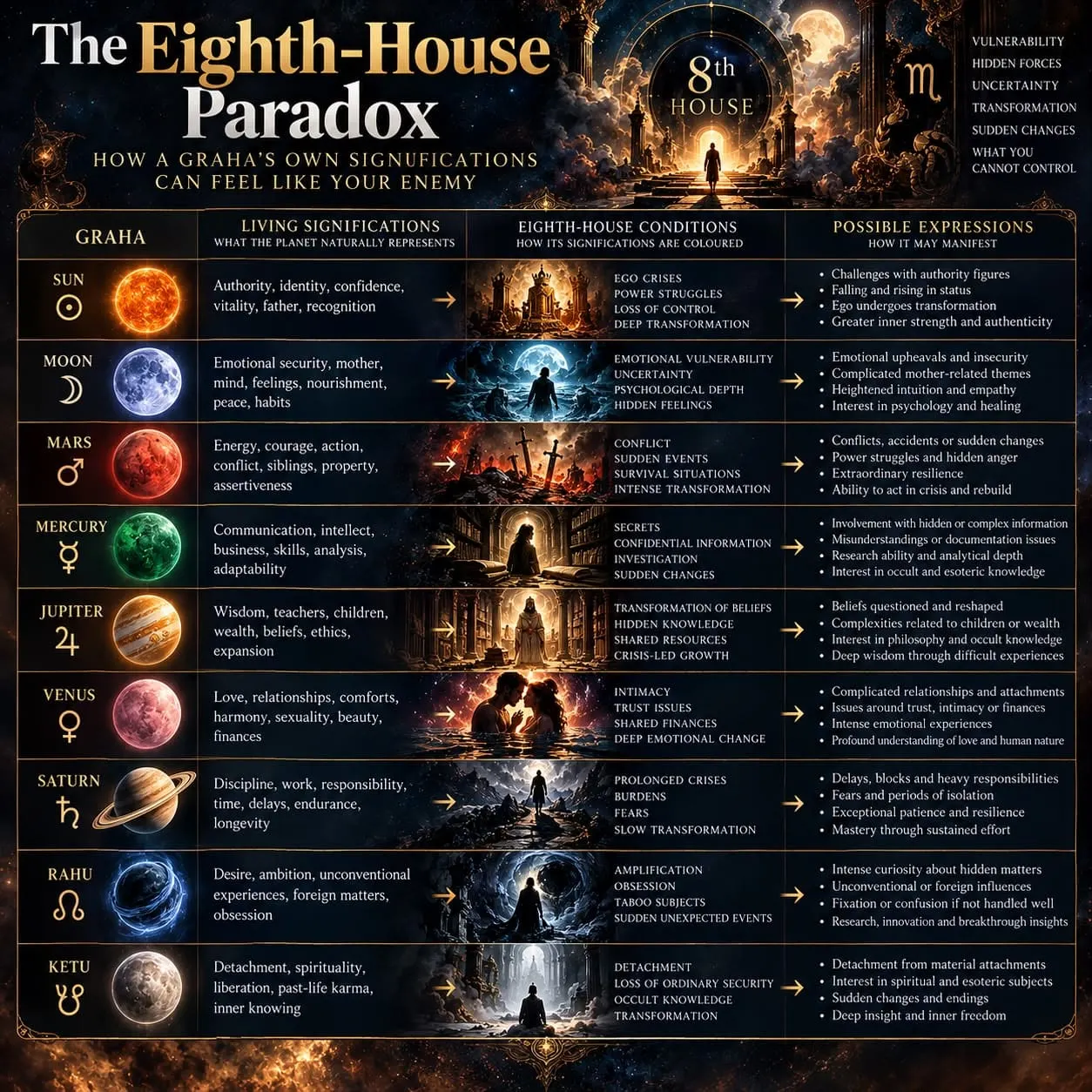
The Sun naturally signifies identity, authority, vitality, recognition and father-related themes. The Moon signifies the mind, emotional responsiveness, nourishment and mother-related themes. Mars signifies energy, courage, initiative, conflict and the capacity to act. Mercury signifies intellect, communication, reasoning and commerce.
Jupiter signifies wisdom, teaching, guidance, ethics and expansion. Venus signifies relationships, harmony, pleasure, comforts and material enjoyment. Saturn signifies time, labour, responsibility, discipline, limitation and endurance.
Rahu and Ketu are interpreted through their own symbolic frameworks, associations, dispositors and the traditions applied to them.
These are not the only significations of the planets, nor do they operate identically in every chart.
A planet may signify a person through its natural karakatva, a life area through its house lordship, and an event or responsibility through its placement and associations.
For example, Venus may be considered for relationships through its natural significations, while the seventh house and its lord provide additional information about marriage and partnership. The exact role of Venus varies with the Lagna and the rest of the horoscope.
Similarly, Saturn may signify labour and responsibility naturally, but its functional role depends on the houses it rules for the particular ascendant.
This is why a planet cannot be interpreted through a single keyword.
What changes when a planet connects with the eighth house?
The planet retains its significations. The eighth-house connection introduces another dimension into their interpretation.
The Sun continues to signify authority and identity, but the astrologer must examine whether these matters are connected with questions of control, vulnerability, concealment or significant change.
Venus continues to signify relationships and pleasure, but its eighth-house connection may direct attention towards intimacy, trust, shared resources and the consequences of emotional exposure.
Mercury continues to signify communication and reasoning, but the astrologer may investigate confidential information, complex research, incomplete knowledge or the consequences of information that emerges unexpectedly.
The planet’s significations have not been replaced. They are being interpreted in a different context.
This leads to a useful interpretive principle:
The eighth house can make the conditions surrounding a planet’s significations more important than the significations themselves.
The astrologer must investigate not only what the planet represents, but also how those matters are situated within the horoscope.
- The Vulnerability Interface: An Interpretive Framework
The relationship between a planet and the eighth house can be examined through what may be called the vulnerability interface.
This is an interpretive framework developed for understanding the relationship between planetary significations and eighth-house themes. It is not a named classical doctrine.
The framework asks how a life area represented by a planet interacts with vulnerability, uncertainty, hidden conditions and significant change.
Consider four stages.
Stage one: The signification.
Identify the person, relationship, responsibility or life area represented by the planet through its natural significations and functional lordship.
Stage two: The eighth-house connection.
Establish how the planet is connected with the eighth house: through occupation, lordship, conjunction, aspect or another clearly defined relationship.
Stage three: The nature of the vulnerability.
Investigate what kind of eighth-house issue may be relevant. Is the question about shared resources, concealed information, uncertainty, a major change, dependence on another person or the limits of personal control?
Stage four: The possible expression.
Evaluate the complete chart to determine whether the configuration supports a difficult, constructive or mixed interpretation.
This framework prevents the astrologer from moving directly from a planetary placement to an accusation or prediction.
For example, Venus connected with the eighth house may justify investigating trust and shared finances in a relationship. It does not establish infidelity.
Mercury connected with the eighth house may justify examining confidential information and communication. It does not establish backbiting.
The difference between an interpretive possibility and a factual conclusion must remain clear.
- Why Can a Planet’s Significations Feel Like an Enemy?
The word enemy is particularly important here because it can refer to two different things.
In astrology, an enemy may mean a planet that is naturally or functionally inimical to another planet, according to a particular Jyotisha framework.
In ordinary experience, an enemy is a person or force perceived to be acting against us.
Neither meaning is identical to the experience of difficulty.
A planet’s significations may become associated with challenging circumstances without the planet becoming an astrological enemy or the people it signifies becoming literal enemies.
Why, then, can the experience feel so adversarial?
4.1 The importance of the signification
The more important an area of life is to a person, the more consequential difficulties in that area may feel.
A challenge involving a distant acquaintance is not experienced in the same way as a challenge involving a spouse, a parent, a livelihood or a deeply held sense of identity.
When an eighth-house connection involves a particularly important signification, the experience may be more personally consequential.
This is one reason the same general astrological theme can be experienced differently by different people.
4.2 Uncertainty and incomplete knowledge
The eighth house is associated with hidden matters and conditions that may not be immediately apparent.
When a planetary signification is connected with such themes, the astrologer may investigate situations in which the person does not possess all the information needed to understand or manage the circumstances.
Uncertainty can be uncomfortable precisely because it limits the ability to make confident decisions.
A relationship may be difficult to navigate when its expectations remain unclear. A financial arrangement may become complicated when important terms are not understood. A professional situation may become stressful when the person cannot establish what is happening behind the scenes.
These are illustrative possibilities, not guaranteed results of eighth-house placements.
4.3 The limits of control
Some situations cannot be resolved through direct effort alone.
Relationships involve other people’s choices. Shared resources depend on more than one person’s decisions. Institutional processes may involve delays and requirements outside an individual’s control. Information may emerge only after a period of uncertainty.
The eighth-house connection can be interpreted as bringing attention to these limits.
The difficulty may lie not only in the event itself, but also in the inability to determine its timing, prevent it or resolve it immediately.
4.4 The exposure of a vulnerability
A consequential event may reveal a weakness that was already present.
An unclear agreement may become a problem when circumstances change. A relationship may reveal incompatible expectations when greater intimacy develops. An existing financial vulnerability may become apparent when responsibilities increase.
The event can appear sudden even when the underlying conditions developed over time.
This is one way to understand the relationship between hidden conditions and visible consequences.
4.5 The conflict between expectations and reality
People often develop expectations about how particular areas of life should function.
Love should provide affection. Authority should provide confidence. Intelligence should provide clarity. Effort should lead to predictable results.
Real circumstances do not always conform to these expectations.
When a planet’s significations are connected with eighth-house themes, the astrologer may investigate whether those areas of life are associated with situations that require the native to reconsider established assumptions.
This does not mean that suffering is always necessary for transformation. Nor does it mean that every difficult event has a predetermined spiritual purpose.
It means that a horoscope may be interpreted as describing areas in which uncertainty and change deserve particular attention.
- The Eighth House and Backbiting: A Technical Examination
One interpretation associated with eighth-house symbolism concerns hidden opposition, private criticism, concealed hostility and information exchanged outside a person’s awareness.
The reasoning is that backbiting takes place in the absence of the person being discussed. Its consequences may become apparent only after the conversation has occurred.
This interpretation is understandable within a broader framework of concealment and vulnerability. However, backbiting should not be presented as an exclusive or universally accepted primary signification of the eighth house.
A technically sound analysis must distinguish the houses associated with speech, communication, reputation, adversaries and concealed matters.
The second house is associated with speech, family, accumulated wealth and values. The third house is relevant to communication, expression and effort. The sixth house is commonly examined for disputes, competition and adversaries. The seventh concerns other people, partnerships and agreements. The tenth and eleventh may become relevant when professional reputation, public standing or social networks are involved.
The eighth house may add a dimension of concealment, vulnerability or consequences that emerge unexpectedly.
The actual interpretation depends on the question being asked and the relationships between the relevant houses, lords and planets.
The second house as the eighth from the seventh
The second house is eight houses away from the seventh when counted inclusively in the conventional derived-house method.
This relationship is an application of bhavat-bhavam, the technique of examining a house in relation to another house.
Because the seventh house represents partnerships and other people, the eighth from it can be examined for matters associated with the partner’s vulnerabilities, resources or consequential changes.
The second house, meanwhile, directly signifies speech among its other associations.
However, the derived-house relationship does not prove that the second house represents how a person backbites others. That conclusion is an additional interpretive hypothesis.
Nor does the eighth house alone prove that others are speaking against the native.
An astrologer may investigate speech and concealed interpersonal dynamics through relevant combinations, but must not confuse a symbolic possibility with evidence that a particular person has acted maliciously.
- Scorpio Is Not Automatically the Eighth House in Every Horoscope
Scorpio is the eighth sign in the natural zodiacal sequence beginning with Aries. This gives Scorpio a symbolic correspondence with eighth-house themes in the Kalapurusha framework.
However, the eighth house of an individual’s natal chart is determined by the Lagna and the house sequence.
For an Aries ascendant, Scorpio occupies the eighth house in the standard whole-sign framework. For other ascendants, Scorpio may occupy an entirely different house.
Consequently, three distinct conditions must not be confused:
- A planet occupies the eighth house from the Lagna.
- A planet occupies Scorpio.
- A planet has a meaningful relationship with the eighth lord or eighth-house significations.
These conditions may overlap, but they are not identical.
A planet in Scorpio must be interpreted according to its sign condition, house placement, lordship and associations. A planet in the eighth house must be examined according to the sign it occupies and the condition of its dispositor.
Scorpio does not automatically make a planet harmful, and an eighth-house placement does not automatically turn the planet into an enemy.
The natural zodiac provides a symbolic reference, not a substitute for the individual horoscope.
- The Eighth House from the Lagna and the Moon
The reference point matters when assessing a planet’s eighth-house relationship.
Eighth from the Lagna
The eighth house from the Lagna forms part of the foundational natal chart.
Its sign, lord, occupants, aspects and relationship with other houses must be considered together.
When examining a planet’s connection with the eighth house from the Lagna, the astrologer should first establish whether the connection is direct or indirect and what it means within the full chart.
Eighth from the Moon
The Moon provides a different interpretive reference point, especially when examining the mind, emotional responsiveness and the subjective experience of circumstances.
The eighth from the Moon may be considered when investigating how uncertainty, hidden conditions or consequential changes relate to the Moon-centred framework.
However, it should not automatically be treated as a diagnosis of psychological suffering, emotional instability or betrayal.
The Moon’s condition, its relationships with other planets and the broader horoscope remain essential.
Why the distinction is necessary
A planet connected with the eighth house from the Lagna is not necessarily connected with the eighth from the Moon.
If both reference points produce a relevant connection, the astrologer may investigate whether the two perspectives reinforce a particular theme. If they differ, the differences should be interpreted rather than ignored.
The same principle applies to Scorpio: a planet in Scorpio is not automatically an eighth-house planet in the natal chart.
Rigorous interpretation begins by identifying exactly what is being examined.
- The Living Significations of Each Planet Connected with the Eighth House
The following sections explore the possible interaction between each graha’s significations and eighth-house themes. They are interpretive possibilities, not guaranteed outcomes.
Sun: Authority, Identity and the Experience of Exposure
The Sun signifies identity, vitality, authority, recognition and father-related themes.
When connected with the eighth house, these significations may be examined in relation to changes in status, power dynamics, private family matters or situations that challenge the native’s established sense of authority.
A person may need to reconsider how they exercise authority or how much their confidence depends on maintaining control.
In some charts, father-related relationships or dealings with superiors may become consequential. Such outcomes cannot be concluded from the Sun’s placement alone.
Constructive expressions may include the capacity to investigate complex systems, understand the dynamics of authority and develop a more resilient sense of identity.
The Sun’s dignity, lordship, aspects and strength determine how these possibilities should be evaluated.
Moon: Emotional Security and the Unknown
The Moon signifies the mind, emotional responsiveness, nourishment, habits and maternal themes.
Its connection with the eighth house may be examined in relation to uncertainty affecting emotional security.
Some individuals may become particularly attentive to changes in relationships or family circumstances. Others may develop an interest in psychology, investigation, spiritual traditions or the hidden dimensions of human behaviour.
The placement does not establish that the mother will cause suffering or that the native is destined for emotional instability.
The Moon’s sign, dignity, lordship, aspects and relationship with the fourth house and its lord are relevant to the wider interpretation.
The central question is how the individual’s emotional responses interact with uncertainty and change.
Mars: Action, Conflict and the Response to Crisis
Mars signifies energy, courage, initiative, competition, conflict and decisive action.
When connected with the eighth house, Mars may bring attention to circumstances involving sudden change, intense pressure, hidden tensions or the need to act under difficult conditions.
Depending on the horoscope, this may be relevant to disputes, property matters, technical research or situations that require sustained courage.
A difficult expression may involve impulsive reactions or the escalation of conflicts when information is incomplete.
A constructive expression may involve investigation, technical competence, courage and the ability to respond effectively under pressure.
The placement alone does not establish accidents, violence or conflict with siblings. Mars’s condition and the relevant houses must be examined.
Mercury: Communication, Reasoning and Confidential Information
Mercury signifies intellect, communication, calculation, commerce, reasoning and adaptability.
Its connection with the eighth house may be interpreted through complex information, investigation, confidential matters, documentation or the consequences of knowledge that was previously unavailable.
A person may be drawn towards research, auditing, analysis, financial scrutiny or the study of esoteric subjects.
Difficult expressions may involve misunderstandings, incomplete information or complications that arise when assumptions are accepted without verification.
Mercury in the eighth does not automatically indicate gossip, lying or backbiting.
The astrologer must examine Mercury’s condition, associations, house ownership and relationships with relevant houses before making a more specific judgment.
Jupiter: Wisdom, Belief and the Reconsideration of Assumptions
Jupiter signifies wisdom, teaching, guidance, ethics, children, expansion and belief.
When connected with the eighth house, its significations may become relevant to the investigation of inherited knowledge, complex responsibilities, shared resources or experiences that challenge established beliefs.
Some people may develop a serious interest in philosophy, metaphysics, Jyotisha or spiritual inquiry.
Others may reconsider their assumptions after encountering a consequential change in circumstances.
These possibilities do not mean that Jupiter in the eighth necessarily harms children, teachers, wealth or morality.
Jupiter’s natural significations, functional lordship, dignity, strength and associations must be considered together.
Venus: Relationships, Intimacy and Shared Vulnerability
Venus signifies affection, attraction, pleasure, harmony, comforts, relationships and material enjoyment.
When connected with the eighth house, the astrologer may investigate how intimacy and attachment interact with vulnerability, shared finances, privacy and significant change.
Relationships may require deeper discussions about trust, boundaries or unequal expectations. Alternatively, the person may develop a greater appreciation for emotional complexity and the psychological dimensions of intimacy.
Neither expression is inevitable.
Venus in the eighth does not automatically indicate infidelity, divorce, betrayal or an unhappy marriage. Marriage must be assessed through the seventh house and its lord, relevant significators, the Navamsha and the operating planetary periods, among other factors.
The key question is how affection and attachment function when vulnerability becomes important.
Saturn: Time, Responsibility and Endurance
Saturn signifies time, discipline, labour, responsibility, limitation and endurance.
Its connection with the eighth house may be examined in relation to prolonged processes, complex obligations, uncertainty that requires patience or responsibilities that cannot be resolved immediately.
A difficult expression may involve rigidity, fear of uncertainty or a feeling that important matters require sustained effort.
A constructive expression may involve careful planning, realism, persistence and the ability to work methodically through complex circumstances.
Saturn’s placement does not independently predict a shortened lifespan, a specific illness or inevitable suffering.
Its dignity, functional lordship, strength and relationship with the Lagna and other relevant factors must be considered.
Rahu: Amplification, Obsession and the Unfamiliar
Rahu is often interpreted through desire, amplification, unconventional experience and the pursuit of what lies beyond established boundaries.
Its connection with the eighth house may draw attention to hidden matters, intense curiosity, taboo subjects, investigation or an urge to uncover what remains unknown.
In a constructive expression, this may accompany research, technological curiosity or a sustained interest in complex subjects.
In a difficult expression, uncertainty may become an object of fixation, leading to suspicion or conclusions that exceed the available evidence.
Rahu in the eighth does not prove that someone is plotting against the native or practising harmful occult rituals.
The relevant task is to examine the complete configuration and distinguish disciplined investigation from an unsupported assumption that every hidden matter involves an enemy.
Ketu: Detachment, Inwardness and Hidden Knowledge
Ketu is commonly associated with detachment, discontinuity, inwardness and a movement away from ordinary forms of identification.
Its connection with the eighth house may be examined through hidden knowledge, impermanence, spiritual inquiry and the limits of conventional explanations.
Some people may develop an interest in contemplative practices, occult traditions or research that requires looking beneath appearances.
Others may struggle to sustain engagement with matters that demand practical continuity.
Ketu does not automatically grant spiritual attainment, occult mastery or liberation. Nor does it necessarily destroy the significations of a planet with which it is associated.
Its interpretation depends on the associated graha, sign, house, dispositor, relevant lords and the complete horoscope.
- Rahu, Ketu and Conjunctions: Why One Combination Cannot Be Interpreted in Isolation
A planet connected with the eighth house may also be conjunct Rahu, Ketu, Saturn, Mars or another graha.
Such combinations require a separate assessment of the planets involved.
A conjunction is not simply the addition of two keywords. Its interpretation depends on the planets’ respective significations, dignity, functional lordship, sign, degree relationship, aspects and dispositor.
Venus conjunct Rahu does not automatically indicate betrayal. Mercury conjunct Ketu does not independently establish deception. Saturn associated with a planet in the eighth house does not necessarily mean that its significations will produce prolonged suffering.
Where a planet has both an eighth-house connection and a significant nodal association, the astrologer may investigate whether themes of uncertainty, attachment, detachment or unconventional experience become prominent.
Prominence, however, is not synonymous with damage.
A configuration may have difficult, constructive or mixed expressions, depending on the full horoscope.
The importance of divisional charts
The D1 birth chart provides the foundational natal framework.
The D9 Navamsha is particularly important in traditional Jyotisha for marriage-related analysis and additional assessment of planetary strength and dharma. Its indications must be interpreted in conjunction with the D1 chart.
The D60 Shashtiamsha is used in some traditions for subtle karmic analysis. Its interpretation requires particular care because of its sensitivity to birth-time accuracy and differences among astrological traditions.
A conjunction in D9 or D60 is not automatically equivalent to the same conjunction in D1.
Nor should a single divisional-chart configuration be used to declare that a spouse is an enemy, that a person is destined to suffer or that a specific karmic debt must be paid.
The astrologer must establish which chart is relevant to the question, whether the birth time is sufficiently reliable and how the divisional indication relates to the natal chart.
- Why the Same Eighth-House Placement Can Produce Different Experiences
One of the most important principles in advanced Jyotisha is that the same planetary placement does not produce identical results in every horoscope.
Consider Venus connected with the eighth house.
For one ascendant, Venus may rule houses associated with constructive results; for another, its functional role may be substantially different. Its sign dignity, aspects, conjunctions and strength may also vary.
One chart may support an interpretation centred on shared finances. Another may draw attention to intimacy and emotional vulnerability. Another may suggest an interest in the psychological or esoteric dimensions of relationships.
The same principle applies to Mercury, Saturn, Jupiter and the other planets.
A planet’s natural significations provide one layer. Its functional lordship provides another. The eighth-house connection supplies another. The remaining chart determines how these layers must be integrated.
This is why placement-by-placement descriptions should be treated as starting points rather than complete predictions.
- Planetary Strength: Why Difficulty Does Not Eliminate Constructive Potential
A planet connected with the eighth house is not necessarily incapable of producing constructive results.
Its strength and condition matter.
The astrologer must examine the planet’s sign dignity, house ownership, aspects, conjunctions, dispositor, relevant divisional placements and appropriate strength measures such as Shadbala.
The condition of the eighth lord is also important, as are the relationships between the eighth house and other relevant houses.
A strong planet may be better able to deliver its significations, but strength alone does not determine whether those results will be favourable. Functional lordship and the nature of the question remain essential.
The eighth house’s associations with concealed matters and complex processes can also be relevant to research, investigation, specialised knowledge and the careful management of shared resources.
However, these abilities cannot be guaranteed from an eighth-house placement alone. Other relevant factors must support the interpretation.
The correct conclusion is not that every eighth-house planet produces suffering or that every strong eighth-house planet produces mastery.
It is that a complete astrological judgment must account for both difficult and constructive possibilities.
- Dasha and Bhukti: When Do These Significations Become Relevant?
A natal placement describes an astrological configuration; it does not, by itself, establish when a particular event will occur.
Planetary periods, including dasha and bhukti, form part of the traditional framework used to assess timing.
When a planet connected with the eighth house operates through its dasha or bhukti, an astrologer may investigate whether its natal significations become more prominent during that period.
However, this does not mean that every eighth-house theme will manifest during the planet’s period.
The interpretation depends on the planet’s natural significations, functional lordship, placement, associations and relationship with the houses relevant to the question. Transits and other timing considerations may also be examined according to the chosen tradition.
A period associated with an eighth-house planet may involve significant changes, but the nature of those changes cannot be determined from the house placement alone.
The same technical discipline applies when examining whether an experience concerns relationships, finances, professional responsibilities, family matters or another area of life.
- What an Eighth-House Connection Does Not Prove
The eighth house is particularly vulnerable to exaggerated interpretations because its symbolism includes hidden matters, vulnerability and consequential change.
A planet connected with the eighth house does not automatically prove that:
- Someone is secretly plotting against the native.
- A spouse, parent, friend or colleague is an enemy.
- A person will inevitably experience betrayal, divorce or abandonment.
- The planet’s natural significations will be destroyed.
- Every difficult experience is punishment for past-life karma.
- Rahu or Ketu proves occult attack or malicious intent.
- A placement in D9 or D60 overrides the entire D1 chart.
- A strong eighth-house planet guarantees occult powers, wealth or spiritual attainment.
Such conclusions require more than a single placement, and some claims cannot be established from an astrological chart at all.
A horoscope can be interpreted within a traditional symbolic framework. It cannot independently prove another person’s hidden intentions or establish the factual cause of every adverse event.
The distinction is essential to responsible astrological practice.
Conclusion: The Planet Is Not Necessarily the Enemy
The eighth house occupies a distinctive position in Jyotisha because it directs attention towards longevity, vulnerability, hidden conditions, shared resources and circumstances that may bring significant change.
When a planet is connected with this house, its significations must be examined in that context.
The Sun may bring authority and identity into the discussion. The Moon may bring emotional security into focus. Mars may raise questions about action and conflict. Mercury may draw attention to information and reasoning. Jupiter may involve wisdom and belief. Venus may involve intimacy and attachment. Saturn may involve responsibility and endurance. Rahu and Ketu may introduce additional themes according to their associations and the interpretive tradition being applied.
But none of these planets becomes an enemy merely because its significations are connected with the eighth house.
A difficult relationship is not necessarily a hostile relationship. A concealed matter is not necessarily evidence of conspiracy. A period of uncertainty is not proof of karmic punishment.
The complete horoscope must be examined before a meaningful judgment can be made.
The most useful question is therefore not, Which planet is working against me?
It is:
Which areas of life are connected with vulnerability and change in my horoscope, how are those connections expressed, and what does the complete planetary configuration reveal about their possible manifestations?
This approach recognises the complexity of Ashtama Bhava without reducing it to fear, fatalism or a list of inevitable misfortunes.
It also preserves the central discipline of Jyotisha: a planet must be understood through its significations, its role in the individual chart and its relationship with the other factors that determine its results.
The eighth house does not make every planet an enemy. It invites the astrologer to investigate the conditions under which a planet’s significations operate—and to distinguish genuine astrological difficulty from assumptions that go beyond the evidence of the horoscope.
At KarmikVault, the study of grahas, bhavas, nakshatras, divisional charts and planetary periods is approached as an integrated system in which no single placement is sufficient to explain the entirety of a person’s life.